
Vilas County Former Property Owners
Working backward through former Vilas County property owners starts with the newest deed. That instrument names the grantor who conveyed the parcel. You then search that earlier owner as a grantee on an older deed, and repeat. The county's LandShark landing page does not state its earliest online year. Older instruments may live in deed books or microfilm. So ask the Register of Deeds before assuming a start date.
| Source | Years It Covers | Where Held | What It Shows |
|---|---|---|---|
| LandShark party or tract index | Online cutoff not stated publicly | Register of Deeds portal | Recorded parties and land instruments |
| Older deed books or microfilm | Ask the office for the available span | Register of Deeds / counter | Earlier transfers where held |
| Recorded plats and surveys | Instrument-specific dates | LandShark or Register of Deeds | Subdivision, lot and boundary references |
| Probate and court files | Case-specific access and coverage | Clerk of Circuit Court / WCCA | Estate events and related dockets |
Begin with the newest deed and its legal description. Search the property records backward online until the index stops returning a solid match. At that point, ask the Register of Deeds. They can explain which older books, films or counter indexes cover the period. A directory, obituary or plat can add color, but only the recorded deed proves ownership.
Vilas County Former Owners' Deed Chain
Every deed names a grantor and a grantee. The current owner's acquisition deed points to the party who conveyed the land before them. Search that prior owner as a grantee. Compare the tract described, then repeat the pattern. This backward walk only works when the same land matches across each instrument. So keep parcel number, section, town-range, lot and survey clues close at hand.
- Locate the latest deed and note its grantee, grantor, date and legal description.
- Search the grantor as a grantee to find that party's acquisition.
- Match the tract description and record the new grantor and grantee pair.
- Repeat until the portal no longer reaches the needed date, then ask about older volumes.
- Grantor
- The party that transferred an interest.
- Grantee
- The party that received the interest.
- Chain of title
- The ordered series of transfers tied to the same land.
- Legal description
- The parcel identity carried in a deed, plat or survey.
Vilas County Prior Owners and Index Coverage
LandShark publishes no earliest year for its online coverage. The public landing page gives no cutoff either. The Register of Deeds can say which indexes cover a target period. Both online and paper indexes should be asked about. No official source documents a courthouse fire in Vilas County. Nor does any record mention destroyed deed books. A gap in results deserves checking, not an assumed explanation.
Historical research. Use former-owner records for title work, estate research and house history. Do not use a past address or name to track or harass a living person.
Vilas County Former Owners and Grantor-Grantee Steps
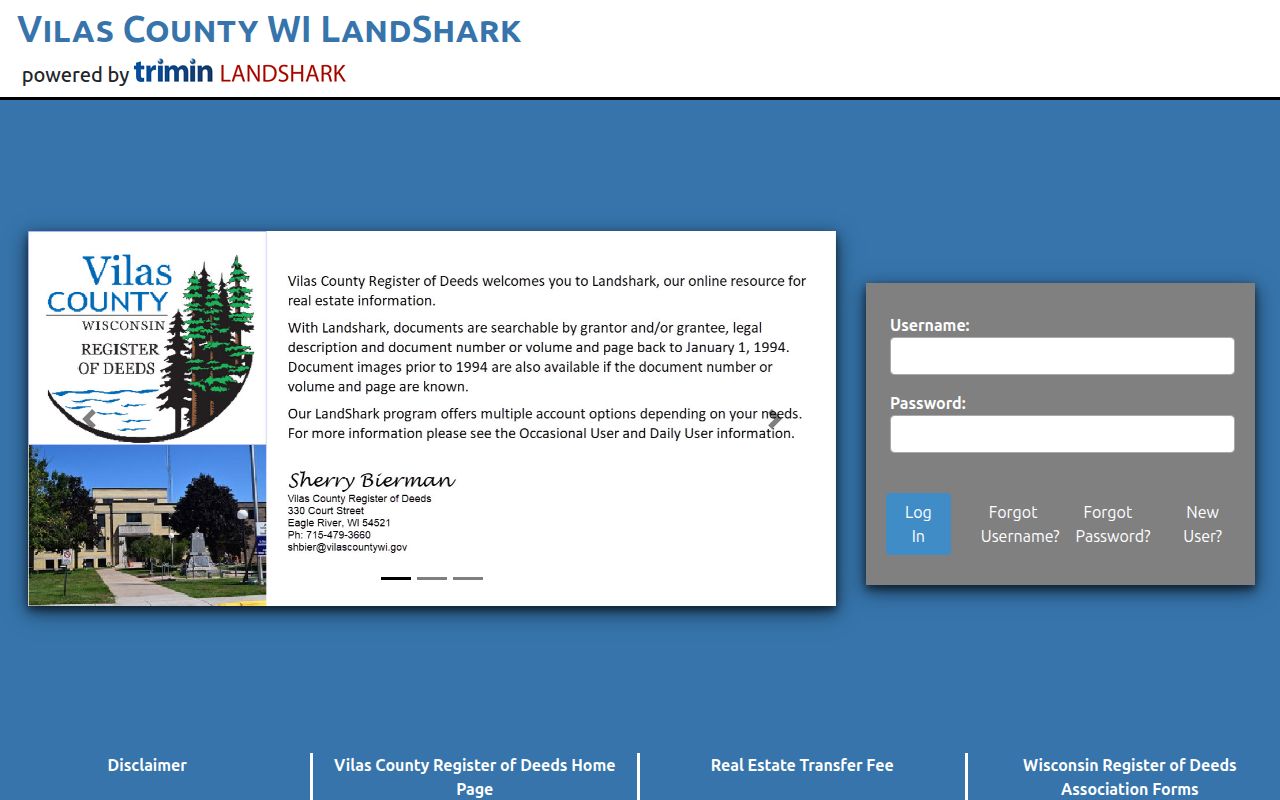
LandShark supports both party and tract search. A party index can show a name as grantor or grantee. A tract search helps when the legal description is known. Try precise entity spellings and likely name variants. Never accept a result on the name alone, though. Match the instrument date, recording reference and tract wording against the deed already in hand. The Register of Deeds posts index entries the next working day. Images follow by noon. That rule covers fresh transfers, not the depth of decades the index reaches. The Vilas County LandShark portal is the online starting point. A chain built on the wrong parcel can look complete while describing a different lot. The legal text matters at every step.
Vilas County Former Deed Images Before 1997
Older scans can be hard to read even when the index entry is clear. Documents recorded before 1997 carried no legibility requirement, the Register of Deeds notes. Blue or light ink may appear faint. A surname, acreage figure or boundary call can vanish in a low-contrast copy. Compare all pages, attached exhibits and nearby references before trusting a transcription.
When the online image defeats you, ask the office about a counter copy, the original deed book or microfilm. The office does not publish an earliest available year. Request the cutoff and book references for the specific transfer. The Vilas County LandShark index is where the backward chain begins.
Record gaps should be documented as search limits, not filled with a guessed transfer.
Vilas County Former-Owner Legal Descriptions Over Time
Addresses change as rural roads get names or properties are readdressed. The legal description is the steadier key. Vilas County deeds may cite a government lot. They may also use section-town-range, a platted subdivision, a certified survey, a lake name or acreage. A tax bill shortens the description. Compare the full recorded wording and any exceptions before linking an older deed to the modern parcel. Historic Eagle River plats offer a concrete example. The Original Plat and the Lion's Club / Lake Park Addition materials name lots, blocks, alleys and old street references. Those details can tie an early deed to a current PIN. But the plat record itself must confirm the lot, not a modern map label. Keep lot and block, parcel ID and current situs together in your chain notes.
Vilas County Former-Owner Estate Transfers
Estates can break a clean person-to-person chain in Vilas County. A deceased owner's parcel may move through a personal representative, trustee, or beneficiary. Only later does a deed reach LandShark. Probate files explain who had authority and when. But the recorded deed is still the transfer that counts. Run the deceased party's name through the Vilas County deed index. Pull a case summary through Wisconsin Circuit Court Access. Ask the Clerk of Circuit Court about opening the full file.
Names also shift after marriage, entity formation, or estate administration. Match the capacity shown on the instrument, the legal description, and the exact spelling. The WCCA case search is a starting point for docket details. It is never a substitute for the deed chain itself.
Lake properties passed down through family estates often require probate context. Pair it with the recorded transfer sequence side by side.
Vilas County Former Owners and Older Sources
Deed chains sometimes reach past the online index. When yours does, the Register of Deeds can help in person. Ask staff about deed books, microfilm, or a counter index that covers the older years. The county library may also hold directories, newspapers, plat histories, and photographs. The local historical society may hold these too, plus obituaries. Staff can give you an inventory. Check before counting on any particular run of volumes.
A name in a directory or an obituary is a lead, not proof of title. It may point to a prior address, a spouse, or an executor. It may also name an owner of record. Always confirm the clue against a recorded deed, a probate file, or a survey. The county historical society and local libraries are good starting points for house history research. So is the Wisconsin Historical Society. And when an image is unclear or a year seems missing, ask what survives before deciding a record was truly lost.
Requesting a Vilas County Former-Owner Search
A focused request works better than a broad one. Instead of asking for every past owner of an address, hand the Register of Deeds a defined starting point. Include the newest instrument number and the grantor and grantee exactly as shown. Add an approximate date range, the Parcel ID, and the full legal description. Then ask which deed books, indexes, or microfilm cover the next period back. Also ask whether the search can happen at the counter or needs a written request. The public LandShark landing page does not publish the earliest online year. So the office must confirm the cutoff for your property and date.
Older scans can be hard to read. Vilas County notes that records made before 1997 were not subject to a legibility requirement. Blue or light ink may be faint. Check every page and attached exhibit before transcribing a name or a boundary call. If a scan is unclear, ask whether an original volume or another copy can be consulted. Keep notes on which years and indexes you searched. That way a later researcher can tell a real gap from an unsearched period.
Note: Contact the Register of Deeds at 715-479-3660 or registerofdeeds@vilascountywi.gov, and verify current counter arrangements on the county office page.